
WHERE LAW STILL RULES
The Conspicuous Jump in Trump’s Win Rate as Cases Move from Lower Courts to SCOTUS
October 2025
When the Trump administration tried to send National Guard troops into Chicago and Portland, bipartisan judges in federal district court blocked him. Trump lost his appeal in the Chicago case to the federal circuit court—but in the Portland case, two Trump-appointed judges on the Ninth Circuit Court of Appeals voted in favor of allowing Trump to deploy the military in U.S. cities. Now, Trump has asked the Supreme Court to intervene on his behalf in the Chicago case. And Trump has every reason to expect the Roberts majority will side with him, given their track record of letting him run rampant over our laws and constitution.
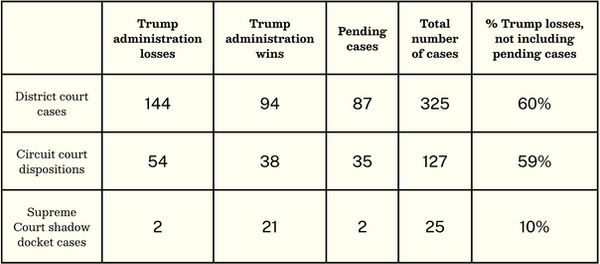
Taken together, these cases reinforce the pattern Court Accountability identified in our new analysis of President Trump’s win-loss rate in the federal courts this year. Our findings reveal that the district courts are engaged in a bipartisan fight for the rule of law—but when cases against the administration reach the circuit courts, Republican-appointed judges have largely voted in Trump’s favor, often writing ideologically driven dissents that their MAGA allies on the Roberts Court have then adopted to enable Trump’s autocratic rule.
-
District Courts: Trump’s challengers have a 60% win rate in the nearly 240 orders issued by federal district courts. Republican-appointed district judges have ruled against him in 55% of the cases before them. Democratic-appointed judges have ruled against him in 63% of the cases before them.
-
Circuit Courts: Trump’s challengers have a 59% win rate across just over 90 orders issued by federal circuit courts. Republican-appointed circuit judges, however, have given 84% of their votes to Trump, while Democratic-appointed circuit judges have given 85% of their votes against Trump.
-
Supreme Court: Trump has a 90% win rate in the 23 Supreme Court orders included in our analysis. Virtually every case was decided on the Court’s so-called shadow docket, with the right-wing majority often refusing to provide much, if any, reasoning for its result.
The District Courts
On September 30, Senior District Judge William Young issued a 161-page opinion declaring unconstitutional the Trump administration’s attempts to deport student visa holders for their political speech. Judge Young, a Reagan appointee, fashioned his opinion as a letter to someone who sent a threatening postcard to his chambers:

Young is hardly alone among federal district judges from both parties who have been standing up for the American people and “our magnificent Constitution” against the Trump Administration’s lawless attacks.
To date, litigation challengers to Trump’s executive policies have won over 60% of the nearly 240 cases decided in the district courts, with similar win rates before Republican and Democratic judges alike.
In case after case, these district judges have issued lengthy opinions loaded with legal analysis to back up their decisions to side for or against Trump based on the facts before them.
For instance, from the earliest days of Trump’s return to power, Democratic and Republican appointees have uniformly declared unconstitutional Trump’s executive order attacking the 14th Amendment’s guarantee of birthright citizenship.
More recently, both Trump- and Biden-appointed judges blocked Trump from sending the National Guard into Portland and Chicago, respectively. “The President’s determination was simply untethered to the facts,” wrote Judge Karin Immergut, the Trump appointee, before reminding the administration that “this is a nation of Constitutional law, not martial law.”
The Circuit Courts
The federal circuit courts have so far issued 92 orders in around 60 of the nearly 100 cases that have been appealed from the district courts. Of those 92 orders, Trump’s challengers have prevailed almost 60% of the time, a success rate similar to that of their wins in the district courts. But unlike in the district courts, the circuit courts’ respect for the rule of law is not embraced on a bipartisan basis.
Democratic-appointed circuit judges have sided against Trump with 85% of their 199 votes, while Republican-appointed circuit judges have given Trump 84% of their 128 total votes. Many of the Republican appointees had been nominated to pursue the Federalist Society’s right-wing agenda, and it shows. The opinions the MAGA circuit judges have issued in these cases, often in dissent, have served to distort the district courts’ fact-finding and subvert longstanding precedents.
This has been perfectly clear in the challenges to Trump’s order attacking birthright citizenship and his firings of independent agency heads. In the birthright citizenship cases, Republican judges have sought to limit relief issued by the district courts or throw the cases out altogether. And in the agency head firings, Republican judges have sought to further undermine a 90-year-old Supreme Court precedent known as Humphrey’s Executor that the Roberts Court appears eager to overrule.
These positions largely come in dissent because Republican appointees hold a minority of seats in virtually all of the circuit courts considering appeals in the Trump challenges. But those judges in dissent are influential with their superiors in the Supreme Court’s majority, and that influence is growing, with the likes of former Trump private attorney and DOJ official Emil Bove now on the Third Circuit.
The Supreme Court
On the Roberts Court, Republicans rule. And as the Roberts Court begins its first full term of the second Trump administration, Trump has already amassed a 21-2 record on the so-called “shadow docket” to prevent lower court orders against the administration’s lawlessness from going into effect.
After handing Trump sweeping immunity from criminal prosecution last term, the Roberts majority has enabled his lawlessness by—so far—ignoring Acts of Congress, making up new constitutional rules, and defying its own landmark precedents. In most shadow docket cases, the justices haven’t even bothered to tell us why.
Rep. Jamie Raskin, speaking in September at the Judicial Conference, asked:
“What accounts for the dramatic difference between the lower courts, where the President is losing in the overwhelming majority of cases, and the Supreme Court’s Shadow Docket, where the President is winning virtually every time? Well, because the Court refuses to explain itself, we simply have no idea.”
True enough. But in seven of the shadow docket cases, the justices adopted the pro-Trump bottom lines of Republican judges who did explain themselves, sometimes at great length, in the circuit courts below.
In the remaining cases, the justices have left us to guess why they are letting Trump persist in his lawlessness across a wide range of issues from immigration to federal spending, while leaving lower courts without guidance on how to carry out the high court’s unexplained orders.
Members of the Roberts majority’s own views on the precedential value of their shadow docket orders have evolved. In 2021, Justice Alito said the orders have no precedential value, but Chief Justice Roberts this year said they should inform similar subsequent cases—only for Justice Gorsuch to insist that “when this Court issues a decision, it constitutes a precedent that commands respect in lower courts.”
As Rep. Raskin said,
“Orders emerging from the Shadow Docket cannot be entirely non-precedential, as Justice Alito told us, casually informative, as Chief Justice Roberts suggested, and binding precedent, as Justice Gorsuch commands. Simply put, the Court has got to pick a lane. If emergency orders are non-binding, the Court should say so. If they are precedent, then the Court should tell us that—but they should understand that the lower courts will be left to guess where the Supreme Court will land when it finally hears a case in full.”
Lower court judges have echoed Raskin’s concerns. As Politico reported on September 11,
“They’re leaving the circuit courts, the district courts out in limbo,” said Judge James Wynn, an Obama appointee, during oral arguments in a case about the Department of Government Efficiency employees’ access to Social Security data. “We’re out here flailing. … I’m not criticizing the justices. They’re using a vehicle that’s there, but they are telling us nothing. They could easily just give us direction and we would follow it.”
“They cannot get amnesia in the future because they didn’t write an opinion on it. Write an opinion,” Wynn said. “We need to understand why you did it. We judges would just love to hear your reasoning as to why you rule that way. It makes our job easier. We will follow the law. We will follow the Supreme Court, but we’d like to know what it is we are following.”
Soon after that, the 9th Circuit pressed forward with a case the Supreme Court had stayed at an earlier phase in May. “We can only guess as to Court’s rationale when it provides none,” the three-judge panel wrote. Trump took the case back to the shadow docket. On the eve of the start of the new Supreme Court term, the Roberts majority, again without providing much reasoning, sided once more with the administration. “Although the posture of the case has changed, the parties’ legal arguments and relative harms generally have not. The same result that we reached in May is appropriate here,” the majority wrote in an unsigned order.
Justice Ketanji Brown Jackson dissented:
“We once again eschew restraint—ignoring the need for exigency or any other prudent threshold limitation on the exercise of our discretion—and wordlessly override the considered judgments of our colleagues. We once again use our equitable power (but not our opinion-writing capacity) to allow this Administration to disrupt as many lives as possible, as quickly as possible.
I view today’s decision as yet another grave misuse of our emergency docket. This Court should have stayed its hand. Having opted instead to join the fray, the Court plainly misjudges the irreparable harm and balance-of-the-equities factors by privileging the bald assertion of unconstrained executive power over countless families’ pleas for the stability our Government has promised them. Because, respectfully, I cannot abide our repeated, gratuitous, and harmful interference with cases pending in the lower courts while lives hang in the balance, I dissent.”
Inverting the Judicial Pyramid
Justice Robert Jackson famously quipped that the Supreme Court is “not final because we are infallible, but we are infallible only because we are final.” But the Supreme Court is neither infallible nor final when its own decision-making is—as our current Justice Jackson has continuously reminded us—at once egregiously wrong, unexplained, and in service to an antidemocratic executive.
The lower courts, however, have been telling a different story. These federal courts, bound by law and precedent that the Supreme Court flouts, have been hard at work for the last nine months explaining their reasoning for or against Trump to a public whose democracy is under assault.
Among district court judges, this is a bipartisan project, with Democratic and Republican appointees siding against the administration at roughly the same rates. While the outcomes are similar at the circuit level, the vote breakdown is not. There, Republican appointees chosen for their fealty to the Federalist Society have largely voted for Trump at similar rates to his win record before the Roberts Court, but at least they bother to explain themselves.
Both levels, then, can help light the way back to a democracy governed by the rule of law that the Roberts majority has abandoned.
Article III of our Constitution says, “The judicial Power of the United States, shall be vested in one supreme Court, and in such inferior Courts as the Congress may from time to time ordain and establish.” In Trump’s second term, it’s clear that the courts Congress created to be closest to our country's cases and controversies are demonstrating far more respect for the Constitution and the democratic processes it protects than their right-wing appellate overlords sitting on—or auditioning for—the “one supreme Court” ordained by the document that Trump, with their blessing, defies daily.
Lower court judges, then, should not wilt when the Roberts majority accuses them of defiance.
As Judge Young wrote in September, urging we, the people, to defy the would-be tyrant who seeks to divide us:
“I fear President Trump believes the American people are so divided that today they will not stand up, fight for, and defend our most precious constitutional values so long as they are lulled into thinking their own personal interests are not affected.
Is he correct?”
Trump will not be correct if we invert the judicial pyramid and follow Young's lead. We should call out and demand reforms to stop the Supreme Court’s abuse of its outsized power to abase itself before an anti-constitutional executive. We must keep close watch on the circuit courts, which serve as the proving grounds for future Supreme Court justices of both parties. And we should celebrate and protect the independence of the district judges taking up the Trump cases, who are showing how a truly independent judiciary should conduct itself by refusing to bend the knee.
The Data
Our district court analysis is based on statistics last updated on October 14, 2025, in the cases the the Associated Press has collected in its lawsuit tracker. We count each case’s current status.
Our circuit court analysis is based on statistics last updated on October 22, 2025, in the cases Lawfare has collected in its Trump administration lawsuit tracker. Some cases have included several votes at various stages (e.g., stay pending appeal requests, rehearing en banc requests, merits appeal) and we count each of those dispositions.
Our Supreme Court analysis is based on statistics last updated on October 22, 2025, in the cases SCOTUSblog has collected in its emergency docket tracker. We include Trump v. CASA, which the Court ultimately heard on its merits docket rather than the shadow docket; and A.A.R.P. v. Trump, which the plaintiffs, rather than Trump, brought to the Court’s shadow docket. We count Noem v. Abrego-Garcia as a win for Trump because rather than require the administration to “effectuate” Kilmar Abrego-Garcia's return to the United States, as the lower courts had done, the justices instead ordered the administration only to “facilitate” his return.
Summary Table:
District Court Breakdown:

Circuit Court Breakdown by Party:
